
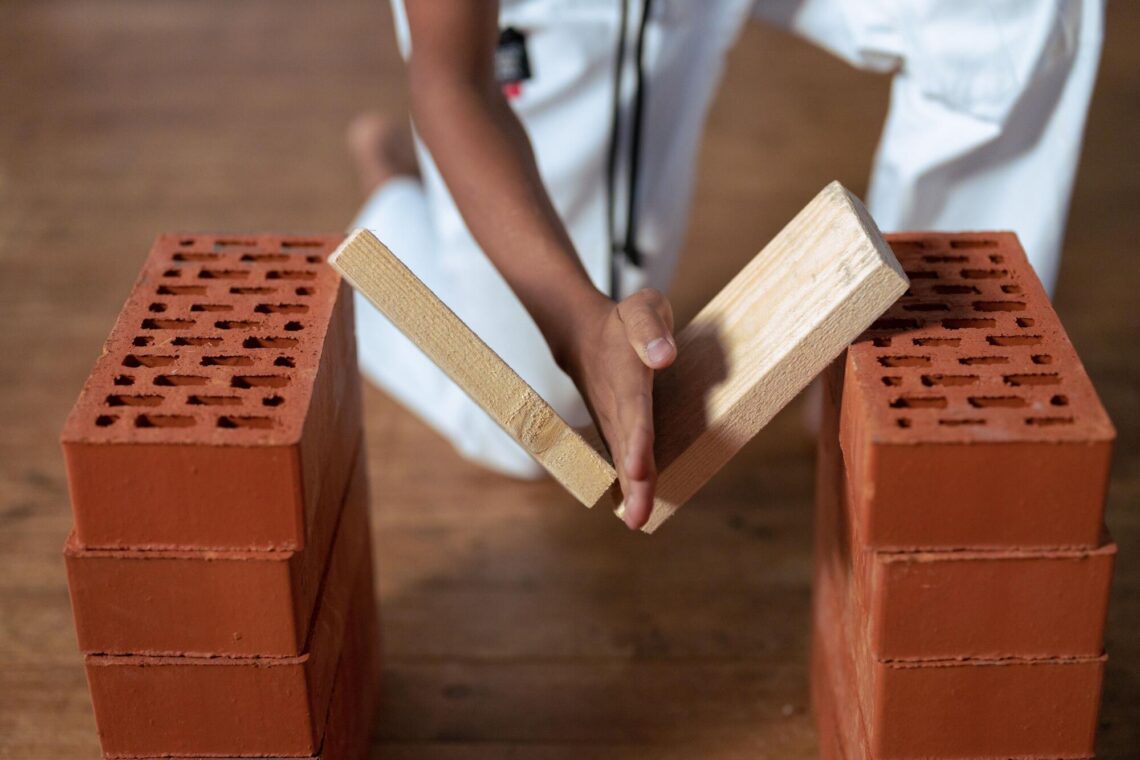
The science of martial arts starts with physics and biomechanics. The physics of kicks and strikes depends on how well you control your mass, force, and movement. Biomechanics help you move as efficiently as possible to execute techniques.
Have you ever wondered how a martial arts expert can break a stack of boards or a concrete block? The answer is physics. A combination of speed, power, and efficiency allows highly trained martial arts students to break boards or bricks without injuring themselves.
Understanding the foundational principles of martial arts movements will help you train for optimal performance. Whether your goals are fitness, competition, or self-defense, you’ll improve faster by training with the science of martial arts.
The Physics of Strikes and Kicks
The physics of strikes and kicks come primarily from Newton’s Laws of Motion. Newton’s laws explain how mass, force, and movement relate to each other.
Newton’s Fundamental Equation
An essential formula for understanding the physics of martial arts is: Force = Mass x Acceleration. If you want more power, you need more body weight or more speed behind your strikes.
Contrary to what many people assume, acceleration is more important to this equation than mass. Training for explosive speed often leads to better results than bulking up to increase body mass.
Transferring Momentum and Energy
Newton’s laws explain how momentum causes energy to transfer from one object to another. For the most powerful strikes, you need the most efficient transfer of energy. This ensures that your force directs fully into the target.
Using Leverage
A final physics concept essential for martial arts is leverage. A lever provides a mechanical advantage by allowing you to move a load more easily. It relies on torque as it rotates on its axis.
In martial arts, you gain a mechanical advantage by positioning your body to maximize torque. More rotational force gives you more power in your strikes and kicks.
Biomechanics of Martial Arts Movements
Proper body mechanics and alignment will help you increase your force and accuracy while lowering the risk of injury. You can engage your entire body mass behind each strike or kick. The exact biomechanics you need will depend on the technique you’re trying to execute.
Front Kick vs Roundhouse Kick
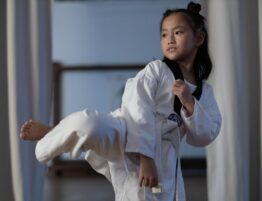
Front kicks and roundhouse kicks are popular techniques because of their effectiveness. They’re typically among the first kicks that a martial arts student learns.
A front kick is a direct linear strike. You can achieve a high energy transfer because the kick travels a straight path. A roundhouse kick is rotational, so you need torque from your hips for the strongest impact.
A study analyzing martial arts techniques published in the journal Sports found that the impact force of a front kick is 120% higher than a roundhouse kick. However, foot velocity is higher for roundhouse kicks.
From the perspective of biomechanics, your hip thrust drives your front kick while body rotation and leg snap drive your roundhouse kick. Researchers in the Sports study found that hip extension velocity was 138% faster for a front kick than a roundhouse. Knee extension velocity was 65% faster for the roundhouse kick.
Injury Prevention Through Proper Technique
Using the right body mechanics for each technique will help you train more safely and effectively. Flexibility and strength are two key areas to focus on. Flexibility gives you a larger range of motion while strength helps you deliver more explosive power without straining.
The Role of Force and Momentum
Accurately directing kinetic energy in martial arts is essential for power and precision.
The kinetic chain for kicking begins with the floor as you drive your supporting leg downward. The downward force creates an equal and opposite upward force that moves through your supporting leg, rotates through your hips, and accelerates your kicking leg.
The kinetic chain for a punch also begins with your legs. Kinetic energy transfers from your legs to your torso, shoulder, and striking arm.
High-level athletes have a more efficient kinetic chain, which gives them technical precision without losing power. They connect their ground force drive with hip rotation and leg or arm extension in just the right timing to reach maximum force when they strike.
Beginners often think that tensing their legs or arms will make their kicks and strikes more forceful. In fact, muscle relaxation allows the kinetic energy to flow more smoothly. A sharp contraction at the point of impact gives you explosive power when you need it.
Frequently Asked Questions
What Has More Power, a Punch or a Kick?
Kicks are typically more powerful than punches. Leg muscles are larger than muscles in the upper body, and legs provide more leverage due to their length.
Whether a kick or punch is a better technique in a combat situation depends on the circumstances, though. Kicks have a longer range, but punches are usually faster to execute and can be more accurate.
Do Taller People Punch Harder than Shorter People?
No, taller people don’t necessarily strike harder than shorter people. Body mass, speed, and good biomechanics are the essential ingredients for more power. Short martial artists can take advantage of these elements just as well as tall martial artists.
What Are the Five Most Important Components of Biomechanics?
Sports biomechanics analyzes human movement to optimize performance. Five key components of biomechanics are:
- Motion
- Force
- Momentum
- Levers
- Balance
When these elements work together properly, you’ll see the benefits in your martial arts training.
Tap Into the Science of Martial Arts
The science of martial arts can help you strike with more power while lowering your risk of injury. Training for optimal performance focuses on biomechanics, explosive power, and precision. You’ll learn how to keep energy moving smoothly through your kinetic chain.
Carrollwood Blackbelt Academy can help you use the physics of martial arts to your advantage. We have been one of the most advanced Tae Kwon Do training centers in the Tampa Bay area since 1999. Whether you’re looking for an after-school program for your kids or a new challenge for yourself, we have a range of classes for all ages and skill levels.
Contact Carrollwood Blackbelt Academy today to schedule your free trial class to see the progress you’ll make with our expert instructors.